
Welcome to the EU-US Forum Weekly Tip Sheet, your go-to product for information about the EU-US Forum and its work, timely updates on the dangerous far-left ideas coming out of the European Union, and detailed analysis on the key players influencing European politics.
We send this out weekly to keep you apprised of the most important political and policy topics in Europe as we continue to work toward our mission of exposing the EU’s radical agenda and the threat it poses to the US and Western Civilization.

1. 🇨🇭 TRUMP AT DAVOS: EUROPE IS NOT RECOGNIZABLE
During his speech at the World Economic Forum this week, President Trump highlighted America’s huge economic successes since he took office. This was a stark juxtaposition to the European Union and the far-left agenda that is hurting their economy.
President Trump slammed Europe for being unrecognizable “in a very negative way.” He followed by saying key issues to a “strong and united” West are energy, trade, immigration, and economic growth.
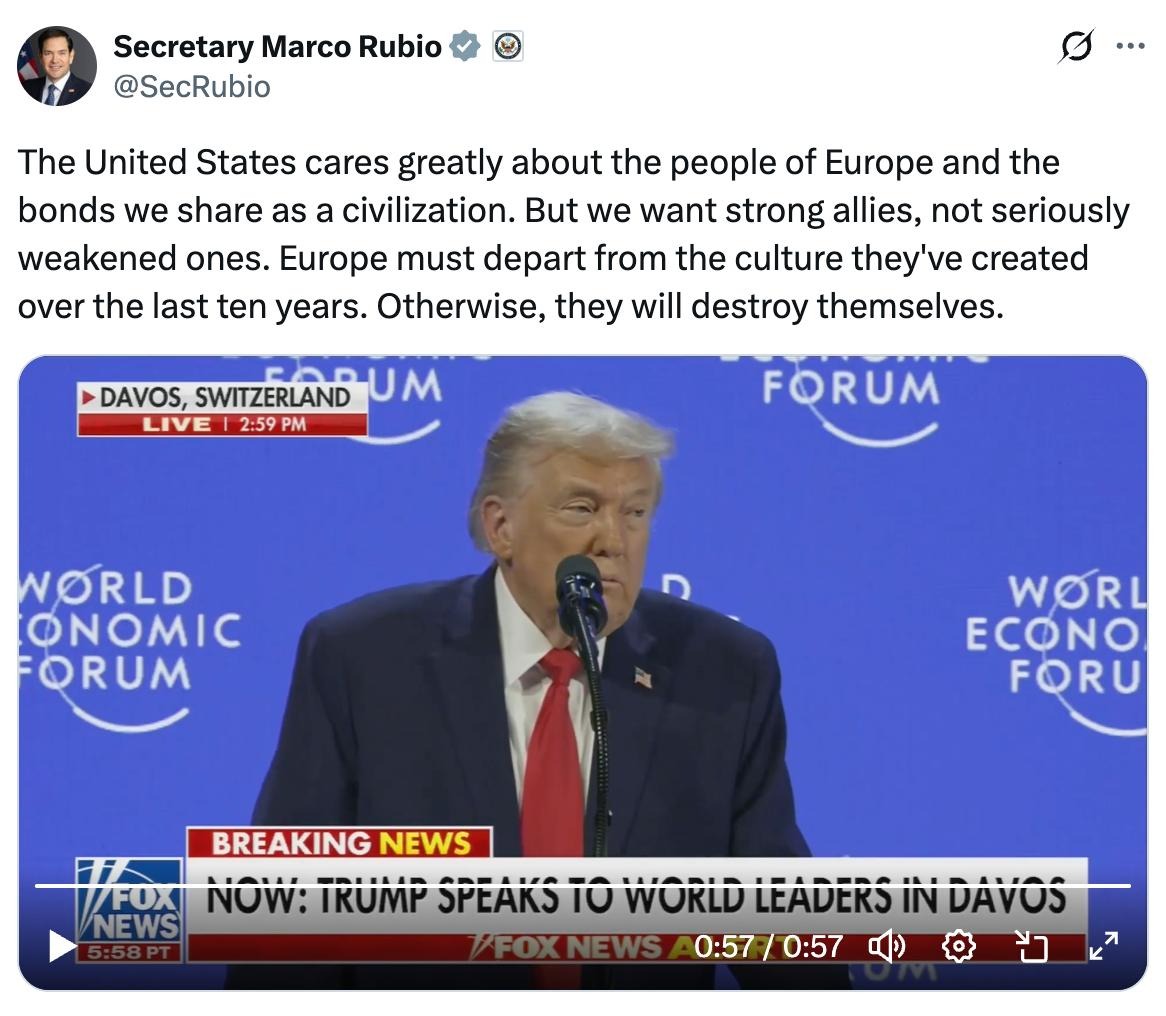
State Department Secretary Marco Rubio amplified the President’s message to Europe, posting on X: “The United States cares greatly about the people of Europe and the bonds we share as a civilization. But we want strong allies, not seriously weakened ones. Europe must depart from the culture they’ve created over the last ten years. Otherwise, they will destroy themselves.”
According to President Trump, Western prosperity was once built on strong borders, sound fiscal policy, and vibrant domestic industry. Instead, he argued that Europe has embraced out-of-control government spending, unchecked mass migration, and reliance on foreign imports.
U.S. Commerce Secretary Howard Lutnick also criticized Europe and their net-zero commitments, making them dependent on China:
“Why would Europe agree to be net-zero in 2030 when they don’t make a battery… so if they go 2030, they are deciding to be subservient to China who makes the batteries.”
In that same breath, France is attempting to continue the growth of foreign investment from China, with the French President Macron calling for more Chinese investment in Europe on the Davos stage: “China is welcome. What we need is more Chinese direct investment in Europe!”
Overall, the Trump administration, across the board, used its time in Davos to speak sense into Europe on all fronts. Now, it’s time to see if they listen.
2. 🌎 THE GLOBAL RISKS OF EU’S DMA
As the EU and the U.S. battle it out over the DMA, a heightened sense of urgency has emerged for America to continue pushing back against European regulations, or instead grapple with the newfound risk of DMA-style policies spreading elsewhere.
Since Europe’s digital regulations entered into force, the framework has been a politically convenient tool to regulate and fine foreign companies. It’s not only generated a windfall for Europe to the tune of $6.7 billion in 2024, but it’s also provided little recourse for victimized companies since virtually all of them are American and lack the European support base to counter such policies.
As detailed in a recent article, the appeal of this ‘no strings attached’ revenue stream represents a grave threat to the US, given its potential to spread elsewhere. Such an expansion of DMA-style regulations would further divert the resources of American tech innovators away from research & development and towards compliance fees, undoubtedly eclipsing the $1 Billion in annual EU-inflicted compliance costs already paid by American companies. Moreover, adoption elsewhere would likely force American companies to abandon certain products and services entirely – even if they’re popular domestically – since navigating each regulatory framework separately wouldn’t be financially feasible.
This is why the U.S. has been so steadfast in its opposition to the EU’s restrictive digital regulations. This fight is not just about protecting American consumers and companies in Europe, it’s about preventing the spread of the EU’s restrictive regulations as well, and it’s one the US cannot afford to lose.
3.🇪🇺 VDL SKIPS CENSURE DEBATE
In a display of contempt for democratic accountability, European Commission President Ursula von der Leyen chose to skip a scheduled European Parliament debate on a censure motion aimed at holding her and the Commission responsible for the controversial EU-Mercosur trade deal. The motion, brought forward by the Patriots for Europe group, highlights concerns that unelected Eurocrats in Brussels are bypassing proper parliamentary oversight and gutting Europe’s agricultural backbone in the process.
In previous weeks, there has been unrest among farmers in Europe over the EU-Mercosur trade deal. The deal would remove a 90% tariff on European products such as cars, cheeses, and wine, while South American agricultural products would receive a massive break, casting European Farmers to the side.
Patriots for Europe leader Kinga Gál blasted von der Leyen’s absence as “contempt” for the thousands of European farmers protesting what they see as ill-advised trade liberalization that threatens local producers.
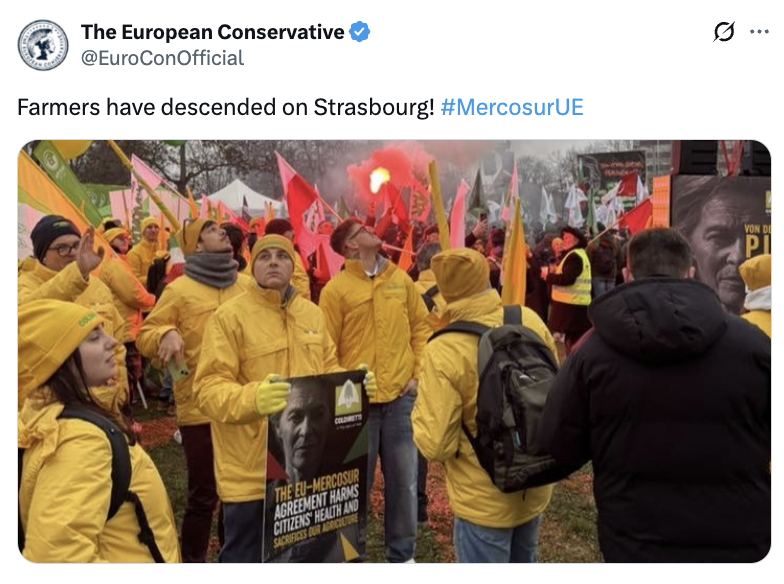
EU Trade Commissioner Maroš Šefčovič insists that no decision on provisional application has been taken, but farmers are still unhappy. In fact, farmers and livestock producers held a large demonstration in Strasbourg on Tuesday.

❌ EU FINES X UNDER DSA, X FIGHTS BACK
A leaked draft of the European Commission’s Digital Networks Act (DNA) suggests the Commission is keeping the door open for “network usage fees” through backdoor language, despite the EU’s commitment in last summer’s U.S.–EU trade framework that it “will not adopt or maintain network usage fees.”
The text introduces an “ecosystem of cooperation” construct and new levers over CDNs and cloud infrastructure that could enable the European Parliament or national regulators to repackage network fees under a different label.
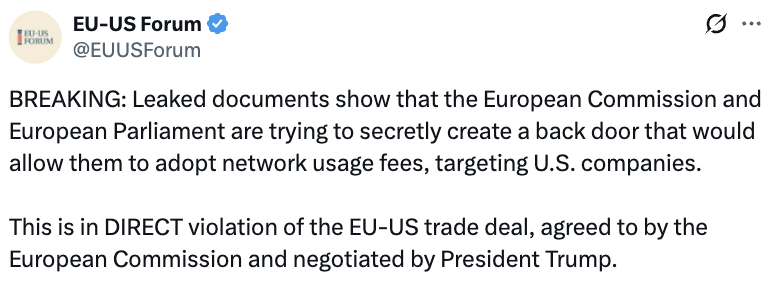
This approach would disproportionately target U.S. internet and cloud services, undermining the transatlantic deal and years of net neutrality policy. By shifting costs onto content/application providers, the proposal risks double-charging, distorting investment incentives, and ultimately raising prices for European consumers and media companies while weakening Europe’s digital competitiveness.
Opposition is coalescing quickly. Industry groups warn that resurrecting network fees, no matter the label, hands windfalls to legacy telcos without delivering better networks, and it invites regulatory fragmentation and trade friction. Digital innovators, cloud providers, and open-internet advocates argue the DNA should focus on pro-competitive, pro-investment measures, not covert fee schemes that breach the spirit of the EU–U.S. agreement.
Bottom line: the leaked draft signals a policy reversal via technical backdoors. The Commission should close those loopholes, explicitly ruling out network usage fees through CDNs or “cooperation” frameworks, and keep the DNA aligned with the transatlantic commitment and open-internet principles.
ALSO IN THE NEWS:
- EU-US Forum: ‘The EU-US Forum praised President Donald Trump for urging the European Union to repeal its CSDDD, warning that the policy could harm U.S. companies and economic growth.’
- European Conservative: “We Have Never Seen You!”: Hungarian Opposition Leader Confronted by Angry Farmers
- European Conservative: France: A Budget at Last?
SEND US YOUR VIDEOS: Do you have videos or stories about the impact of the EU’s disastrous policies? Send us a tip at info@eu-usforum.com