

Welcome to the EU-US Forum Weekly Tip Sheet, your go-to product for information about the EU-US Forum and its work, timely updates on the dangerous far-left ideas coming out of the European Union, and detailed analysis on the key players influencing European politics.
We send this out weekly to keep you apprised of the most important political and policy topics in Europe as we continue to work toward our mission of exposing the EU’s radical agenda and the threat it poses to the US and Western Civilization.

1. 🇮🇸 ICELAND VOTES NO ON EU MEMBERSHIP TALKS
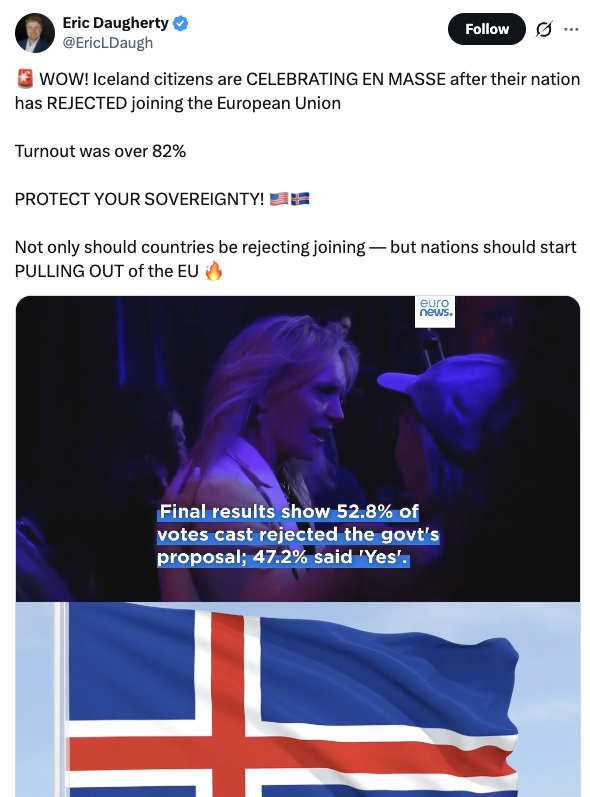
Icelandic voters dealt a decisive blow to EU expansionists Saturday, rejecting a proposal to restart membership negotiations, 52.8% to 47.2%. The result was a rebuke of Prime Minister Kristrún Frostadóttir, who had campaigned to reopen talks with Brussels, and a victory for those who argued that surrendering sovereignty to the EU wasn’t worth the trade.
Opposition leader Gudrun Hafsteinsdottir, who led the winning “no” campaign, stated, “These are not problems that Brussels will solve for us. These are problems that Icelandic politicians must solve.”
Iceland already enjoys access to the EU’s single market and Schengen travel zone without being a full member, and “no” voters saw little reason to give up the independence that arrangement allows.
“By staying independent as we are, we look brightly to the future,” said one Reykjavik voter after casting her “no” ballot.
Canadian Conservative deputy leader Melissa Lantsman put it perfectly in a post on X explaining that if Canada is truly under attack, Carney’s place is in Ottawa, not Strasbourg. The question isn’t whether Canada needs allies; it’s why Carney seems more comfortable addressing Europe’s parliament than his own.
2. 📲EU DMA LEAVES USERS DANGEROUSLY EXPOSED AHEAD OF OCTOBER TRADE TALKS
A new whitepaper released this week details just how costly Brussels’ Digital Markets Act has been for Europeans.
According to its findings, the DMA has caused slower search results for two-thirds of frequent users in the EU. The DMA’s new web-layout has also buried the sites of smaller EU retailers and grocers, while larger, more established chains have been largely unaffected.
The report follows last week’s news that USTR’s Jamieson Greer was invited to join an EU trade ministers’ meeting in October.
USTR Greer and Commerce Secretary Howard Lutnick previously crossed the pond for a similar meeting in November to discuss the EU dialing back its digital regulations, and with the Commission’s digital rulebook still serving as the primary source of tension in the transatlantic relationship, the October meeting is likely to dictate how forceful President Trump’s response to the DMA will be going forward.
While not all EU fines merit a fierce response from the US, like the $250M fine handed down to Meta last week for deciding not to remove over 86% of identified fraudulent ads on the platform, the DMA has made future clashes over fraud and privacy all but unavoidable by opening its users up to unnecessary cyber risks. This includes ordering American companies to share search data with Chinese rivals like DeepSeek, under “anonymization” that can easily be reverse-engineered to identify individuals, and by allowing installation of apps on devices even if they don’t meet established privacy and security standards.
As European confidence in its own regulations begins to erode, USTR Greer should keep every option on the table to ensure the US is best positioned to capitalize on the EU’s waning support at home.

🚨 BRUSSELS EYES CITIZENS’ PRIVATE SAVINGS
The European Union is running low on public funds, and now it wants to tap into the money Europeans have saved in their bank accounts. With member states drowning in public debt and unable to foot the massive bill for their green agenda, Brussels is looking to everyday citizens for a bailout.
Speaking to French business leaders last week, EU Commission President Ursula von der Leyen called the €10 trillion sitting in European household bank deposits “lazy,” arguing that Europe must put that money “at the service of its companies.”
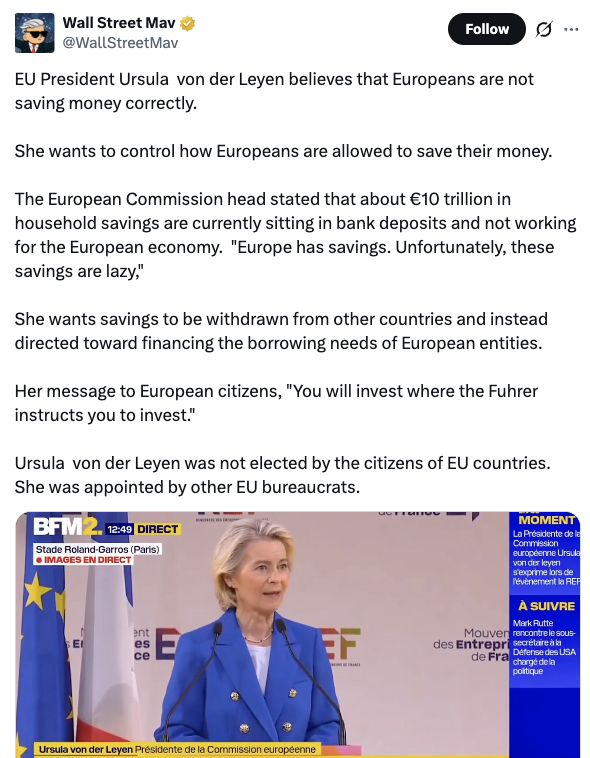
Her proposal would use tax incentives and new financial products to encourage people to move their savings into EU-directed investments in areas like defense, clean energy, and industry.
After years of reckless spending and failed economic programs, Brussels has realized it can no longer finance its agenda through simple taxation.
Managing public money is no longer enough for the eurocrats; they now view your personal bank accounts as a strategic resource to fund their own priorities. They’re coming for your savings, Europe.
ALSO IN THE NEWS:
- Brussels Signal: Swedish Social Democrats slump in latest poll as election race tightens
- Wall Street Journal: Europe Confronts Reality That Vance’s Hostility Is More Than Just a Show
- European Conservative: AfD on Course for Historic Breakthrough in Saxony-Anhalt
SEND US YOUR VIDEOS: Do you have videos or stories about the impact of the EU’s disastrous policies? Send us a tip at info@eu-usforum.com