
Welcome to the EU-US Forum Weekly Tip Sheet, your go-to product for information about the EU-US Forum and its work, timely updates on the dangerous far-left ideas coming out of the European Union, and detailed analysis on the key players influencing European politics.
We send this out weekly to keep you apprised of the most important political and policy topics in Europe as we continue to work toward our mission of exposing the EU’s radical agenda and the threat it poses to the US and Western Civilization.

🛑 EMERGENCY BRAKE ON EU’S REGULATION REGIME
For years, the European Commission has written rules faster than businesses could read them. Now some of its biggest member states want a way to stop it. In a letter to European Council President António Costa, German Chancellor Friedrich Merz, Italian Prime Minister Giorgia Meloni and Belgian Prime Minister Bart De Wever ask for an “emergency brake.” It would let EU capitals halt new legislation they judge too burdensome for governments and businesses.
They also want a new “priority rule” to suspend “certain regulatory areas for a specified period” and “significantly accelerate planning and approval procedures.” The three leaders say the EU’s “common objective should be to prevent unnecessary regulatory burdens and related costs from causing permanent losses of European industrial capacity and further weakening investment and competitiveness.”
The bottom line: Brussels’ regulatory regime is pushing industry out of Europe. Europe’s industrial sector keeps lagging, and Euronews reports the letter could be a flashpoint at this week’s EU leaders’ summit.
European leaders are asking for an emergency brake on Brussels; the regulatory machine has clearly gone too far.
2. 🎤 EUROPE SEEKS TO LABEL U.S. “FOREIGN INFO” THREAT
Some of the EU’s favorite disinformation researchers now want to label America a THREAT to Europe. An investigation found that EU DisinfoLab’s annual conference in Vilnius, which the EU finances, scheduled a session called “USA as a FIMI threat: acknowledge, adapt, push back.” FIMI is “foreign information manipulation and interference.” The session description asks, “How did the United States become a FIMI threat for Europe?”
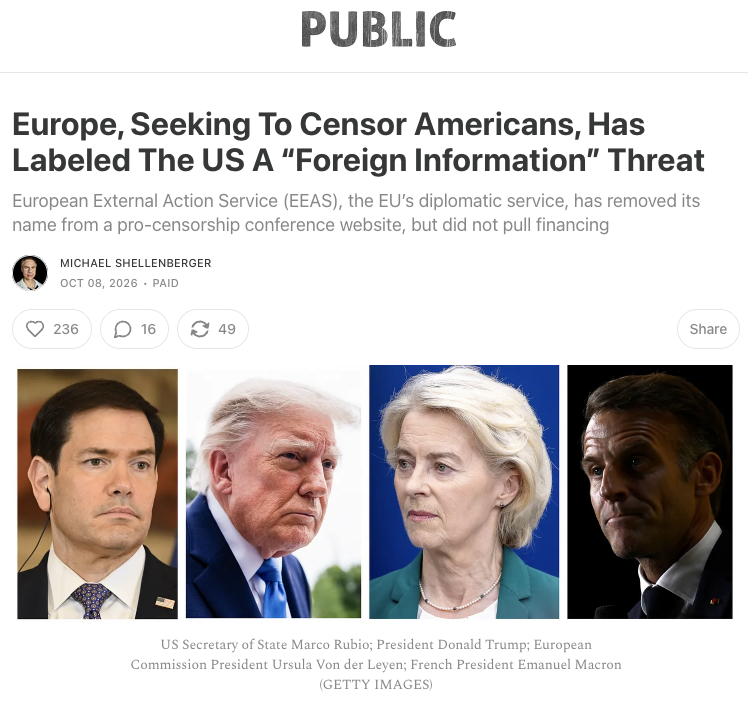
The EU has sent this group about €1.1 million in research grants since 2018: €250,000 for WeVerify, €327,500 for vera.ai, €212,500 for ATHENA, and a new grant of more than €308,000 that runs to 2029. Public reports that the EU’s diplomatic service, the EEAS, quietly removed its name from the conference website but kept the money flowing.
The State Department’s response was blunt. A spokesman said, “We reject that characterization. For too long, governments have exploited the pretext of combating ‘misinformation’ and ‘disinformation’ for politically motivated reasons,” adding that the U.S. has already imposed visa restrictions on five individuals it accuses of censoring Americans, and that the policy “is global and enforceable wherever the facts warrant.”
Brussels wants Americans to believe its anti-free speech agenda is about protecting democracy. It’s hard to square that with taxpayer money going to a disinformation group that treats the U.S. government as a foreign influence operation.

💻 FTC’S MEADOR CALLS OUT EUROPE’S REGULATE-FIRST MODEL
Speaking at the EU Competition Law Conference last week in Brussels, FTC Commissioner Mark Meador broke down the flaws in the EU’s Digital Markets Act. Meador specifically took issue with the DMA’s ex ante regulatory approach that imposes obligations upfront, often without specific evidence of harm, noting that the evidence to date has not indicated that such rules have produced greater clarity, faster relief, or remedies tied to demonstrated harm.
Meador contrasted the two frameworks, noting that, in the U.S., a company asks itself, “What am I not allowed to do?” Under the DMA, however, the question becomes, “What am I allowed to do?” When companies need permission before they act, they have far less room to experiment with new products or respond to changing consumer preferences. This dynamic also helps explain why Europe has seen such a drastic decline in innovation within its tech sector.
The FTC Commissioner also pushed back on an oft-repeated claim by supporters of the DMA that contends ex ante rules provide companies with more certainty. In fact, the opposite is true. The DMA’s obligations are so broadly framed, noted Meador, that “[c]ompanies must guess how regulators will interpret” them, redesign their products, and then wait to find out whether the Commission is satisfied. If firms guess wrong, however, they open themselves up to fines of up to 10% of worldwide annual turnover, or 20% for repeat infringements.
This ex ante regulatory approach has been especially difficult for companies developing or releasing new products that now must weigh the benefits of a launch against the prospect of substantial fines. This has pushed firms to pull new technology out of Europe rather than gamble on loosely defined rules. Apple, for example, recently announced it will not release its new “HomeView” product in Europe due to this lack of clarity, joining features like Siri AI and iPhone Mirroring that have been similarly shelved on account of the Commission’s regulations. Google has faced similar setbacks, stripping flight and hotel information from its EU search results in order to ensure compliance.
If the EU truly hopes to level the playing field and spur innovation in its underperforming tech sector, it must reevaluate its regulatory approach and consider adopting one that, as Meador points out, “has served competition and consumers well for more than a century.”
ALSO IN THE NEWS:
- Breitbart: German Migration System Has Cost Taxpayer at Least €400 Billion: Report
- DW: Greenland: Trump touts major oil, gas, mineral exploration
- BrusselsMorning: EC says “no policy area is out of bounds” when it comes to simplification
SEND US YOUR VIDEOS: Do you have videos or stories about the impact of the EU’s disastrous policies? Send us a tip at info@eu-usforum.com