

Welcome to the EU-US Forum Weekly Tip Sheet, your go-to product for information about the EU-US Forum and its work, timely updates on the dangerous far-left ideas coming out of the European Union, and detailed analysis on the key players influencing European politics.
We send this out weekly to keep you apprised of the most important political and policy topics in Europe as we continue to work toward our mission of exposing the EU’s radical agenda and the threat it poses to the US and Western Civilization.

1. ⛽EUROPE’S WINTER GAS SQUEEZE
Europe’s gas storage is heading into winter at its lowest level for this time of year since records began in 2011, Euronews reports, and prices have tripled in 2026. The Dutch TTF benchmark hit €97.64 per megawatt hour this week, its highest since December 2022 and up about 234% since January. Storage was 74.6% full on Oct 24, against 82.9% a year earlier and 98.5% in 2023. Reserves have also stopped growing, and some countries have already started drawing down winter stocks before November.
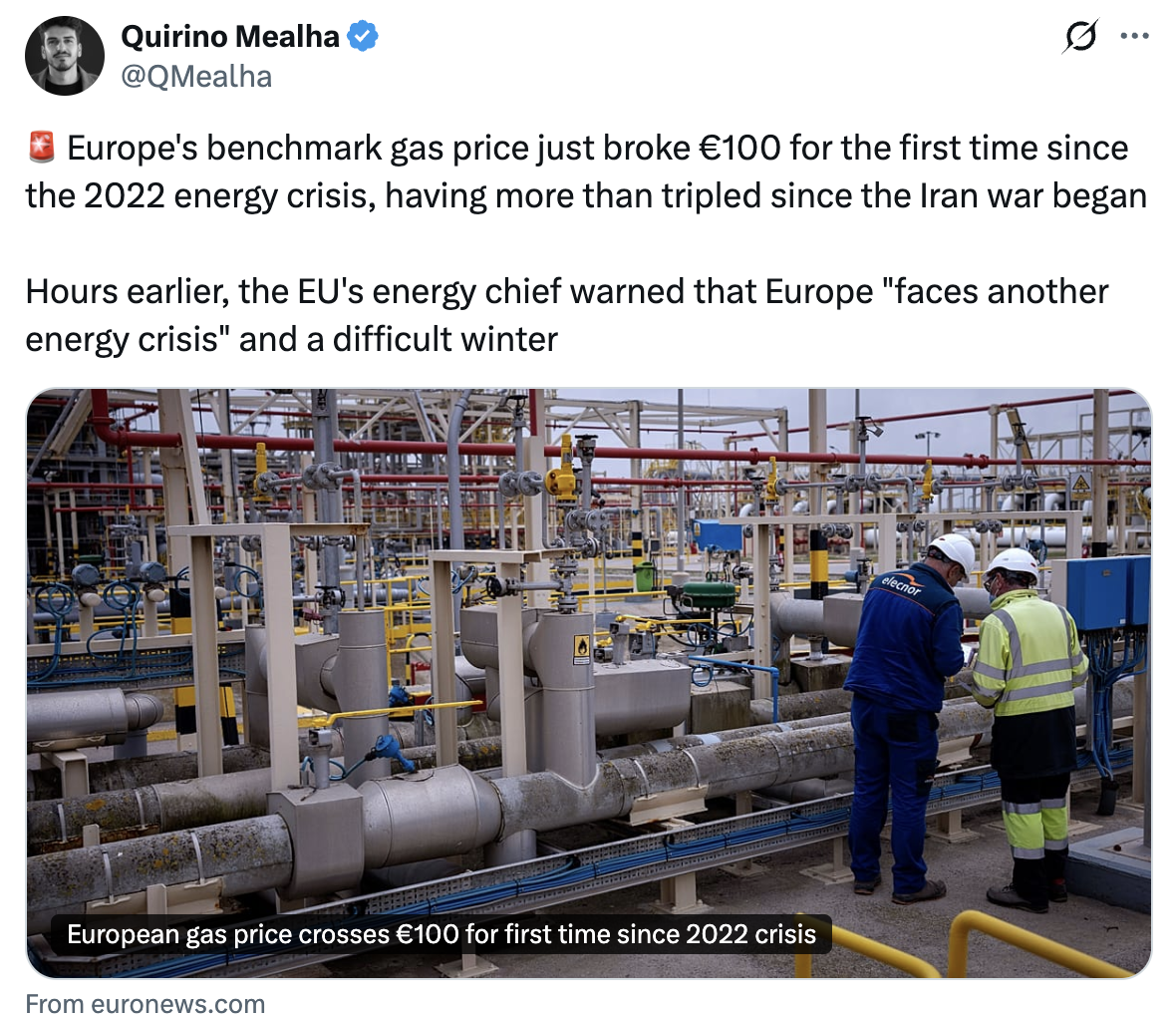
Energy research firm Wood Mackenzie expects storage to be only 17% to 20% full by the end of March, and that assumes a normal winter. Winter futures trade at about €95 per megawatt hour, nearly triple last winter’s average of about €36. Euronews puts the extra cost for a typical gas-heated home at roughly €715 this winter.
The deeper problem is that Europe has stopped producing its own gas. Imports now meet 85% of EU gas demand, according to Wood Mackenzie. Without new investment in domestic fields, the firm says, the bloc will import more than 98% of its gas by 2050. Wood Mackenzie says changing that depends on permitting reform and fiscal stability, which are exactly the areas where Brussels’ climate-first agenda has made drilling harder.
After 2022, Europe promised itself it would never be caught this exposed again. Four years later, with storage at a record low and Brussels still debating whether to coordinate demand cuts, that promise looks broken. As Euronews puts it: “Europe changed its suppliers after 2022. It did not change how much it depends on them.”
2. 🇨🇦🇪🇺 EUROS REJECT VDL’S CANADA PITCH
Ursula von der Leyen’s grand idea of offering Canada “associate member” status in the EU didn’t survive contact with EU governments. Politico reports that Germany, Greece, France and others objected to the idea, and it has been dropped from the joint statement for the landmark EU-Canada summit in Montreal. Von der Leyen floated the offer in her State of the Union speech in September, catching some EU countries off guard, according to Politico.
An earlier draft of the statement committed both sides to define “the concept of Associate Member” by the 2027 EU-Canada Summit, in the name of “prosperity, economic security and strategic autonomy.” That’s gone. The new draft promises only to define “an ever closer association of Canada to the EU, short of full membership itself.” Even the “closer association” wording shifts partway through the text, from “even closer” to “ever closer.”
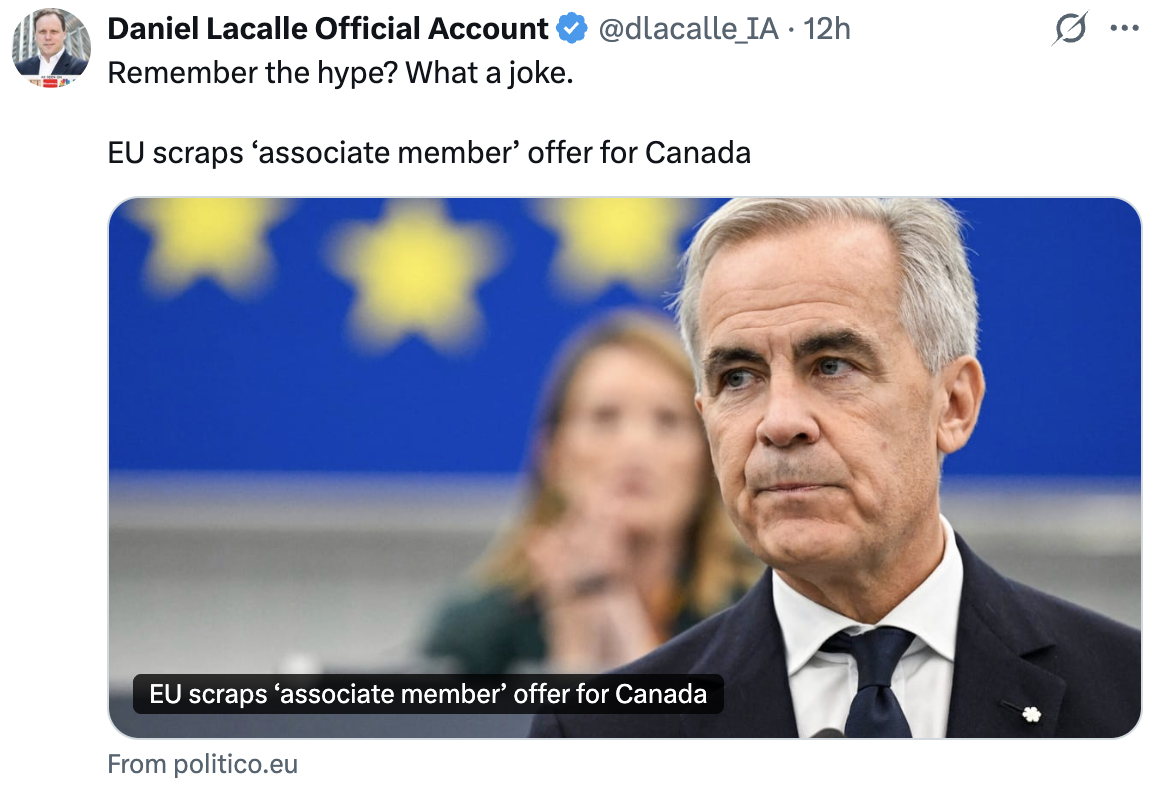
Even Canadian Prime Minister Mark Carney shrugged it off: “it doesn’t matter about specific names or nomenclature.” It’s another case of von der Leyen getting out ahead of the capitals she’s supposed to speak for, and then having to walk it back.

💻 TRUMP ADMIN TIES TARIFF CUTS TO DMA CHANGES
The United States stepped up its pressure on Brussels this past week, warning the EU that it will not lower tariffs on European steel and other goods until the Commission softens enforcement of the Digital markets Act (DMA).
The Trump Administration’s notice, which the Commission passed along to EU capitals at a recent meeting, follows a recent escalation of regulatory aggression by the EU, which handed down a record-breaking $1 billion fine to Google just a few months ago.
President Trump’s decision to press the Commission is not only timely but also fully warranted, given that Brussels is poised to expand its regulatory assault on American tech companies and has provided no indication it plans to slow down.
For one, the EU is preparing to add AWS to the DMA’s list of gatekeepers even though the company does not meet the quantitative thresholds for designation. European officials have also grown more brazen in their rhetoric. Last month, French Europe Minister Benjamin Haddad characterized Brussels’ billion-dollar Google fine as “a new revenue stream for the European Union” that “should automatically lower the contributions of all member states.”
European media commentary further reflects this, suggesting the Commission’s best response to President Trump’s retaliation would be “more taxes” and a “dial[ing] up of investigations of US Big Tech.”
With progressives and the Trump Administration recently finding common ground through their opposition to the DMA, Brussels should not expect a shift in US policy regardless of the outcome of next week’s midterm elections.
The choice is ultimately up to Brussels: spare its steel industry by adjusting its DMA enforcement or prepare for a prolonged trade war with the world’s largest economy.
ALSO IN THE NEWS:
- Politico: US renews push for EU to soften Big Tech rules
- Breitbart: Central Spain: 64 Killed, Dozens More Injured in High-Speed Train Crash
- Politico: Von der Leyen’s coalition fractures over need for AI liability rules
SEND US YOUR VIDEOS: Do you have videos or stories about the impact of the EU’s disastrous policies? Send us a tip at info@eu-usforum.com