
Welcome to the EU-US Forum Weekly Tip Sheet, your go-to product for information about the EU-US Forum and its work, timely updates on the dangerous far-left ideas coming out of the European Union, and detailed analysis on the key players influencing European politics.
We send this out weekly to keep you apprised of the most important political and policy topics in Europe as we continue to work toward our mission of exposing the EU’s radical agenda and the threat it poses to the US and Western Civilization.

1. 🌐 FOOD FIGHT HITS BRUSSELS
The debate over “ultra-processed foods” has gone global, bringing renewed attention to the relationship between international health policy and American consumers. The World Health Organization (WHO) is unveiling a new food profiling tool this week to help governments regulate “ultra-processed foods,” as POLITICO Europe reports.
The development comes as President Trump withdrew the United States from the WHO last year and has called the organization a “corrupt globalist scam.”
The potential costs of a WHO regulation like this one are significant. Looking at the United States, a University of Chicago analysis found that a federal UPF would cost $14.2 billion annually, affecting 72% of packaged foods. Economist Tomas Philipson, a former acting chairman of the White House Council of Economic Advisers, wrote that the push is “bad news for anyone who cares about the cost of healthy eating.” He cautioned that labeling requirements affecting everyday staples like whole-wheat bread could create unintended consequences for consumers.
As policymakers in the United States and Europe consider how to approach “ultra-processed foods,” affordability should remain a central place in the conversation. If we follow the WHO’s lead, this new regulatory framework would lead to spikes in grocery prices for Americans.
2. 🇵🇱 POLAND’S TRIBUNAL CRISIS GOES CONTINENTAL AS LE PEN CALLS OUT BRUSSELS
Poland’s Constitutional Tribunal standoff is now a European political fight. President Karol Nawrocki tried to enter the Tribunal building Friday night during a deadlock over the appointment of eight new judges, and police surrounded the building as the confrontation played out live on television. The opposition has accused Donald Tusk’s government of attempting a coup. The government says it is restoring the rule of law.
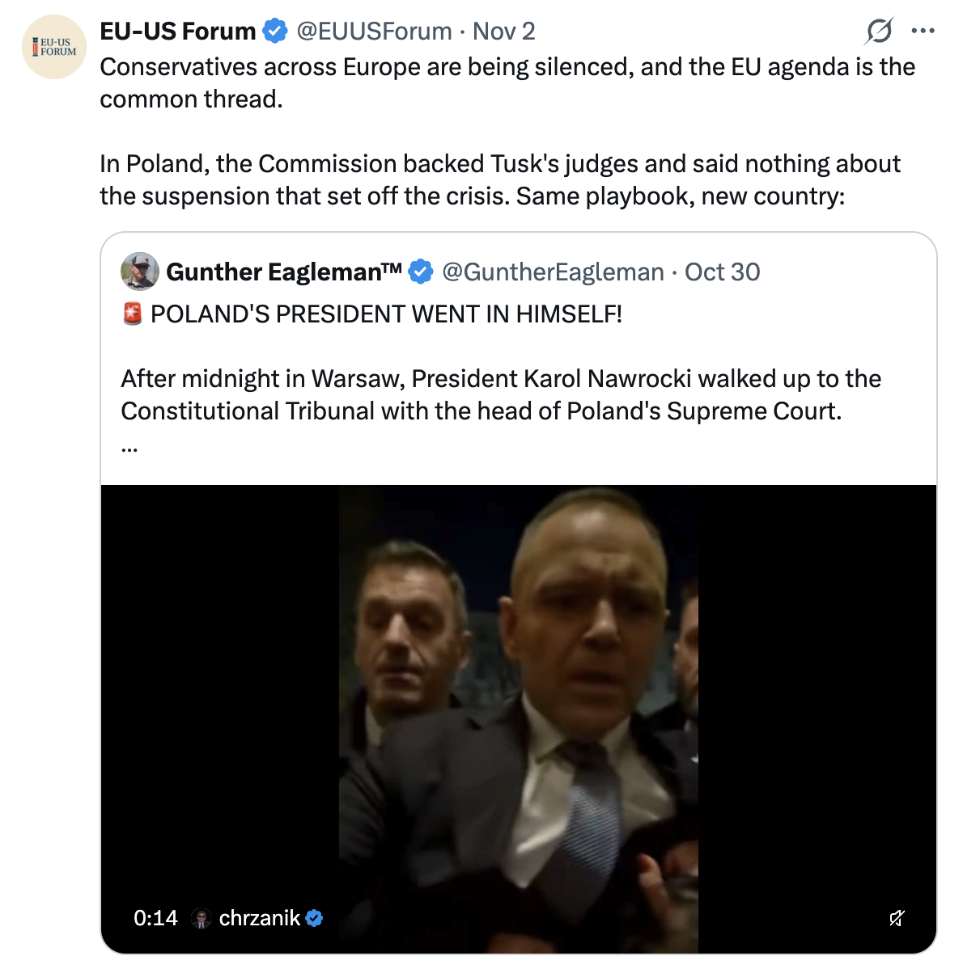
France’s Marine Le Pen, the National Rally’s parliamentary leader, called the crisis a cause for “profound concern.” She wrote on X that “the contested suspension of the Tribunal’s president, and the intervention of security forces around this institution, appear to resemble a forcible takeover of a constitutional body.” She also took aim at Brussels: “The indifference of the European Union and the silence of the media in the face of the Polish crisis are raising legitimate questions: one cannot claim to defend democracy and the rule of law while remaining silent when the constitutional balance of a member state is gravely threatened.”
Brussels’ response shows the problem. The Commission’s statement said the appointment of the eight judges “falls within the constitutional powers of the Sejm.” Brussels talks about the rule of law as a principle that applies to everyone, but it applies it selectively. A Commission that wants to be seen as a neutral referee can’t keep picking winners, and Le Pen’s question about whose rules count is one Brussels still hasn’t answered.

🖥️ INDUSTRY & TRADE GROUPS FIND COMMON GROUND IN DMA OPPOSITION
U.S. technology groups are petitioning the Trump administration to stay on the offensive against Brussels over its Digital Markets Act.
In comments filed with the Office of the U.S. Trade Representative (USTR) for the 2027 National Trade Estimate Report, leading industry groups identified the DMA as one of the primary barriers American companies face in Europe.
In its public comment, the Consumer Technology Association (CTA) warned of the “significant financial and operational risks” that the DMA poses for American companies, companies whom the regulation “disproportionate[ly] impact[s].”
Adding its objections to the DMA, the Information Technology and Innovation Foundation (ITIF) noted how foreign governments have extracted $21.7 billion (and counting) from US Tech Firms since 2018, with the vast majority coming from the EU by way of its digital regulatory framework. The figure represents the highest annual total yet recorded and a $1B increase compared to last year’s sum.
The National Foreign Trade Council (NFTC) shared similar concerns, noting that the DMA “compels the forced sharing of intellectual property, including firm-specific data and technical designs, with EU competitors, effectively requiring U.S. firms to subsidize their European rivals.”
Several trade groups also urged Washington to weigh more robust tactics to combat Brussels’ regulatory agenda, including the ITIF who recommended the USTR pursue “a focused Section 301 investigation with targeted remedies.”
It will be an easy decision for a president who has already fought to prevent American companies from being taken advantage of across the pond and has signaled a willingness to take it a step further if the EU doesn’t reevaluate.
ALSO IN THE NEWS:
- Euronews: 50 million Europeans can’t heat their homes. What is the EU doing to help?
- Daily Signal: The EU Wants to Control What Americans See Online Before We Vote
- Politico: Brussels sets slimline legislative agenda for 2027
SEND US YOUR VIDEOS: Do you have videos or stories about the impact of the EU’s disastrous policies? Send us a tip at info@eu-usforum.com